Why Do I Feel So Disconnected From My Partner? Daily Habits That Actually Help
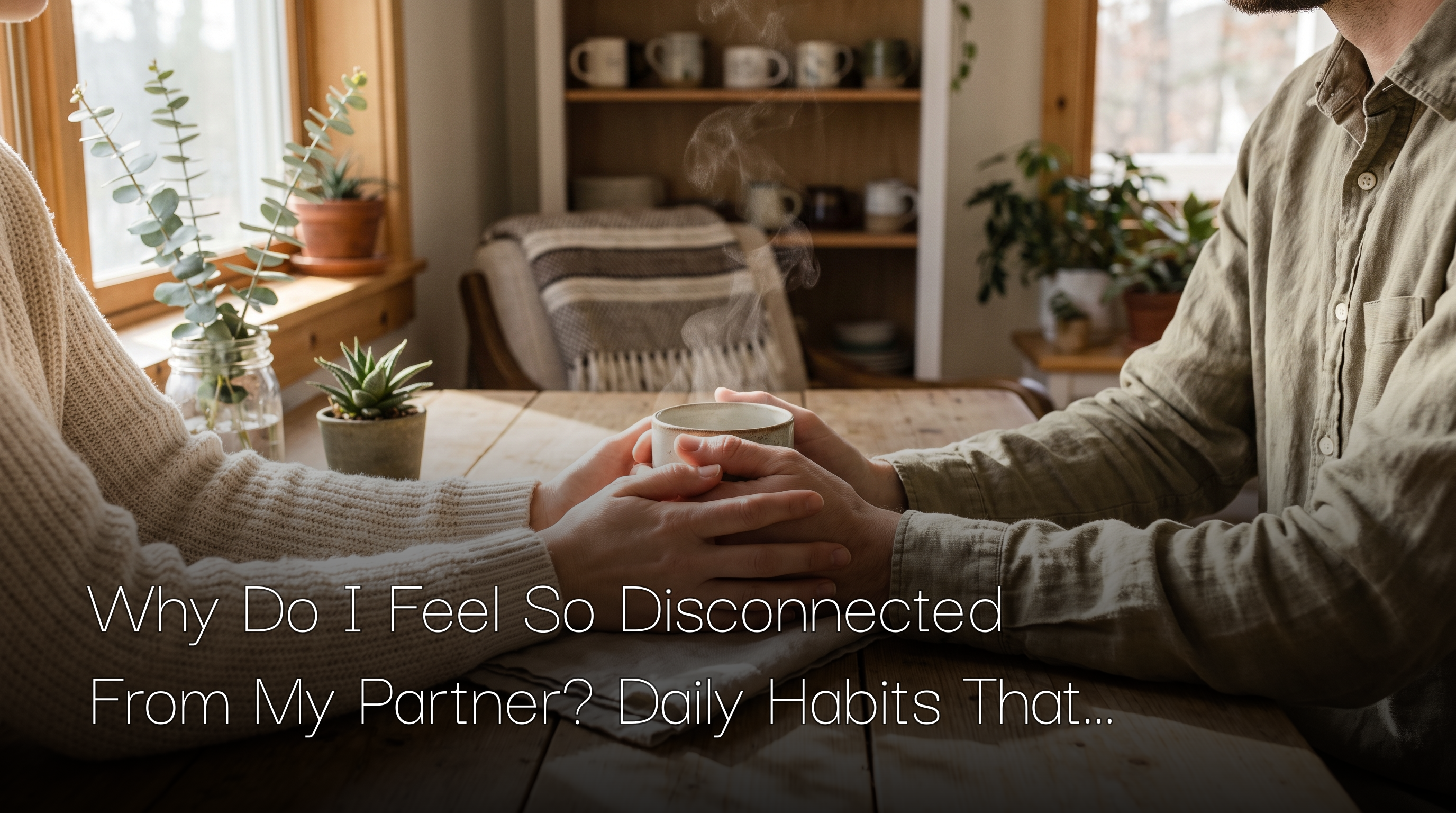
Why Do I Feel So Disconnected From My Partner? Daily Habits That Actually Help
title: "The Quiet Drift: Daily Habits That Help Couples Reconnect" description: "Emotional disconnection in relationships often builds slowly. Here are research-informed daily habits that help couples rebuild closeness, plus why starting with yourself matters." keywords: "emotional disconnection in relationships, mind-body connection for couples, holistic wellness for relationships, couples reconnection habits, daily habits for intimacy"
The Quiet Drift: Daily Habits That Help Couples Reconnect
You're sitting on the same couch. You've eaten dinner together, maybe watched something on TV. And yet there's this quiet, low-grade feeling that you're somehow alone. Not fighting. Not in crisis. Just not quite there with each other.
That feeling has a name. Emotional disconnection. And it's far more common in long-term relationships than most people want to admit.
The hard part isn't recognizing it once it's obvious. The hard part is that it usually creeps in so slowly you don't notice until the gap is already wide.
How Disconnection Actually Happens
Here's what the research says, and it's not what most couples expect: emotional disconnection rarely starts with a single argument or betrayal. It accumulates through small missed moments (Gottman Institute). The "how was your day?" that gets a one-word answer. The observation you almost shared but didn't bother. The hug that got shorter and shorter until it stopped happening at all.
Over time, those micro-misses compound. Partners start to withdraw, communicating less, sharing fewer thoughts, and gradually confiding more in friends or coworkers than in each other (Gottman Institute). The everyday interaction that used to feel nurturing starts to feel transactional. Logistics, not life.
External pressure accelerates it. Work stress, parenting demands, financial worry, even circumstances like long-distance or deployment are all recognized contributors to couples drifting apart (Military OneSource). Stress doesn't just affect your mood — it can affect your overall capacity for connection.
The Mind-Body Link Is Real
Physical and emotional intimacy are not separate systems. They feed each other, or they starve each other.
Regular physical touch, not necessarily sexual, just human contact, releases oxytocin, the bonding hormone that promotes trust and security between partners (Integrated Balance Psychotherapy).
Something as small as a genuine 20-second hug, held long enough to actually feel it, has been cited as a meaningful daily practice for emotional closeness (Integrated Balance Psychotherapy). Twenty seconds. That's not a grand gesture. That's a decision.
When emotional distance grows, physical intimacy often follows it downward. And then the loss of physical connection deepens the emotional distance. It becomes a loop, and both people often feel it without knowing how to name it or break it.
Rebuilding one side genuinely helps the other, and that dynamic is central to any relationship-centered wellness practice built around reconnection.
Daily Habits Worth Actually Doing
Reconnection doesn't require a weekend retreat or a difficult conversation where everything gets said at once. Research and clinical sources consistently point to small, consistent habits as more impactful than occasional large efforts. A few of these are worth looking at closely.
The simplest place to start is the daily check-in, and not the reflexive "how was your day?" variety. Replacing that with something specific, such as "what was the best moment today?" or "is there anything on your mind I should know about?", invites a real answer. It signals genuine interest rather than background noise.
What happens when your partner shares something difficult matters just as much. The instinct is often to fix it. Staying in the listening a little longer before moving to advice, and reflecting back what you heard, communicates more than most people expect. It costs nothing and lands as one of the more underrated daily practices for sustained connection.
Non-sexual physical touch has its own place in this, distinct from everything else. Holding hands, a hand on the lower back when passing in the kitchen, a longer goodbye hug. Physical warmth outside of a sexual context is an important category of bonding that's easy to let slip when life gets busy, and worth actively maintaining.
Shared rituals do similar work, however modest they are. A morning coffee before the kids wake up, a walk after dinner twice a week, a tech-free hour on Sunday evenings. These predictable moments of togetherness become anchors, built not from grand gestures but from showing up consistently. Couples who build this kind of rhythm into ordinary days tend to describe their connection as steadier, their sense of shared energy more resilient.
Then there are the micro-moments that accumulate in ways that often surprise people. Texting "saw this and thought of you," voicing appreciation for something small, saying out loud the random thought that made you think of your partner. These are identified as key building blocks of intimacy (The Therapy Group). They don't require time. They require intention.
Start With Yourself
There's something the research quietly points to that doesn't get said enough: feeling disconnected from your partner often mirrors feeling disconnected from yourself.
When you're running on poor sleep, chronic stress, or a lifestyle that leaves no room for personal reflection, your capacity for genuine connection shrinks. You show up to your relationship depleted. Not because of a character flaw, but because energy that isn't there simply can't be given.
Supporting connection naturally starts with the basics that we tend to deprioritize first: consistent sleep, forms of movement you actually look forward to rather than dread, food that actually nourishes, and some form of stillness, whether that's ten minutes of journaling, a walk alone, or whatever helps you hear your own thoughts again. A grounded daily wellness routine that keeps those fundamentals in place, including rest and nutrition that support your energy and mood, directly improves your presence in the relationship.
Reconnecting with your partner is genuinely easier when you've spent some time reconnecting with yourself. Far from being an indulgence, that kind of self-tending is the very foundation the relationship gets to rest on.
When Habits Alone Aren't Enough
Sometimes the gap has grown wide enough that daily habits, while necessary, aren't sufficient on their own. Persistent difficulty communicating needs, feeling alone even when physically together, unresolved conflicts that keep surfacing without resolution — these are signs that the disconnection has layers that benefit from professional support (celebrateagain.org).
Couples therapy isn't a last resort. It's a tool. If you're reading this and recognizing that the habits above feel impossible to introduce because of something heavier sitting between you and your partner, naming that honestly, to yourself first and then to them, is a brave and practical first step.
You might say simply: "I miss us, and I think we could use some help getting back there." More than a criticism, it's an opening, and sometimes that's exactly what a relationship needs.
A Practical Takeaway
Disconnection is quiet and gradual. So is reconnection, and that's actually good news, because it means the bar for starting is low. You don't need a perfect moment or a cleared schedule. You need a 20-second hug today. A real question at dinner. A text that says "thought of you." These things accumulate, just like the distance did.
Reconnection is less about finding the right technique and more about choosing, repeatedly, to turn toward your partner instead of away. Those small, consistent choices compound over time, and a relationship tended with that kind of daily attention tends to feel more alive for it.
Exploring the role of sleep, nutrition, and daily movement with a healthcare provider is a strong place to start if you're looking to feel more present, both for yourself and for the people who matter most to you.
Bioharmony Group
We believe true health starts from within.. Subscribe to my newsletter.

Why Do I Keep Getting Sick? How to Support Your Immune System Naturally Through Daily Habits Getting Sick Too Often? What Your Immune System Is Trying to Tell You Three colds in four months. Sound familiar? For a lot of people, that pattern feels unavoidable, something to shrug off as bad luck or a "weak constitution." But frequent illness is rarely random. More often, it's a signal. Your body is telling you that something in your daily routine is quietly working against you, and the good...

Fuel your training harder. For a limited time, 10% off our full gym supplement range. Train Harder. Recover Faster. Pay Less. Hey Reader,For a limited time, we're offering 10% off our entire gym supplement range below. No catch, just pure performance at a better price.Shop through the links below and save on your next order. 🔬 Novagenix Creatine Creatine is one of the most researched and proven supplements on the planet, and ours is no different.Why it works:- Rapidly increases strength and...

Why Does My Digestion Feel Off? How to Support a Healthy Gut Microbiome Through Daily Habits You ate a perfectly reasonable meal and still ended up bloated for the rest of the afternoon. Or you wake up tired even after seven hours of sleep, your skin is acting up, and your focus is shot by 2 PM. It's easy to chalk these things up to stress or aging. But a growing body of research points to a different culprit that most people overlook: the state of their gut microbiome. That word - microbiome...