Why Is Your Weight So Hard to Manage Even When You Eat Well?
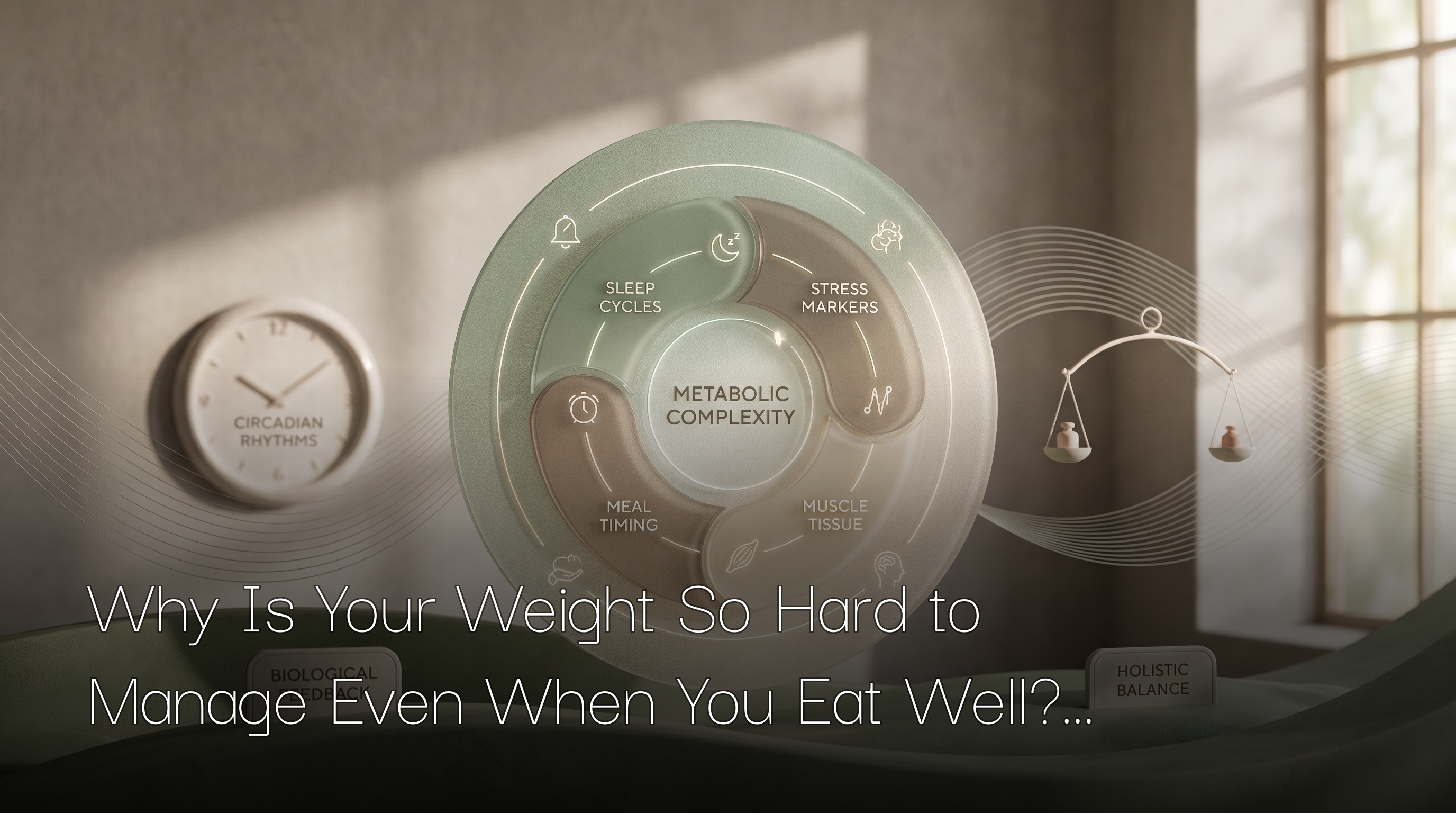
Why Is Your Weight So Hard to Manage Even When You Eat Well?
You cleaned up your diet months ago. You're eating vegetables, cutting back on processed food, watching your portions. And still, the scale barely moves. Or it moves, then creeps back. Sound familiar?
This is one of the most common and genuinely frustrating experiences in health. And it has almost nothing to do with willpower.
Your metabolism is not a simple calculator that just adds and subtracts calories. It is a system shaped by sleep, stress hormones, meal timing, muscle mass, and biological feedback loops that actively work against rapid weight loss. Understanding those forces is the first step toward working with your body instead of against it.
Why Your Body Fights Back Against Weight Loss
Here's something most diet plans don't tell you upfront: the moment you start losing weight, your body begins trying to stop you.
This is called metabolic adaptation. As body weight drops, the body senses potential scarcity and responds by lowering the rate at which it burns calories. Hunger hormones ramp up at the same time, making you think about food more and feel satisfied less. Research from metabolic scientist Eric Ravussin and colleagues shows that extreme rapid weight loss locks in a more severe metabolic adaptation than gradual approaches, and those hunger hormone changes persist long after the diet ends (Levels, citing Ravussin). This is biology, not failure.
This is also why the common instinct to eat less and less can backfire. Consuming fewer than 1,000 calories per day can significantly slow metabolic rate because the body reads it as a threat and shifts into conservation mode (Healthline, 2023). A moderate, sustainable deficit almost always outperforms aggressive restriction over any meaningful time frame, making it one of the most effective approaches to healthy weight management.
Sleep, Stress, and the Cortisol Problem
Two of the biggest levers on your metabolic wellness have nothing to do with food.
Sleep is one. Most adults need 7 to 8 hours per night, and falling short disrupts the hormones that regulate hunger and appetite, which can contribute to weight gain over time (Labcorp, 2023). Less sleep means more ghrelin (the hormone that signals hunger) and less leptin (the one that signals fullness). You can eat a perfect diet and still find yourself reaching for extra food if you're running on five or six hours most nights.
Stress is the other. When you're chronically stressed, your body produces excess cortisol. Cortisol shifts your metabolism toward fat storage, increases overall appetite, and specifically triggers cravings for sweet, fatty, and salty foods (BSW Health). This isn't a character flaw. It's your nervous system doing what it evolved to do in the presence of a perceived threat. The problem is that modern stress is relentless and rarely resolves the way a physical threat would.
For genuine metabolic balance, stress management isn't optional. Even 10 minutes of daily breathwork, a consistent wind-down routine before bed, or reducing evening screen exposure can gradually shift the cortisol picture in a more useful direction.
When You Eat Matters as Much as What You Eat
Meal timing is an underappreciated piece of metabolic wellness. Research published in a 2021 review on optimal dietary strategies found that eating late disrupts circadian rhythms and results in increased free cortisol, decreased resting energy expenditure, and decreased glucose tolerance, with implications for cardiovascular disease risk (PMC, 2021). That's a significant set of consequences from something that often feels like a minor lifestyle detail.
Practically, this means front-loading your calories earlier in the day generally supports better metabolic function than eating most of your food in the evening. Maintaining a consistent eating window, even if you're not following formal intermittent fasting, also helps keep circadian signals intact. If intermittent fasting appeals to you, common regimens include the 5:2 approach (consuming around 900 to 1,000 calories on two days per week) and time-restricted feeding (fasting for 16 to 18 hours per day). Research suggests the benefits extend beyond calorie reduction to metabolic switching and supporting more balanced glucose metabolism (PMC, 2021).
One specific tactic worth trying: eat your carbohydrates last in a meal, after protein, fat, and vegetables. This simple sequencing has been shown to reduce post-meal blood glucose spikes (Levels, 2023). For context, Levels recommends maintaining a mean 24-hour glucose level between 79 and 100 mg/dL and staying below 110 mg/dL after meals to support metabolic health.
The Exercise Equation (It's Not What You Think)
Exercise matters enormously for how to support metabolism naturally, but probably not in the way most people assume.
Running a mile burns roughly 120 to 150 calories depending on body size. That's about one small banana.
Exercise alone is simply not an efficient calorie-burning tool, and treating it as one often leads to frustration and compensatory eating. What exercise does exceptionally well is support and maintain metabolic rate, particularly when it includes strength training.
Muscle is metabolically active tissue. It burns calories even at rest. Building and preserving muscle mass is one of the most reliable long-term strategies for natural metabolic support. Physical activity guidelines recommend 150 minutes of moderate activity per week, plus strength training at least two days per week specifically for this reason (Labcorp, 2023).
Cardio keeps the heart and circulatory system healthy and has real value. But if your goal is lasting metabolic balance, the weights room is at least as important as the treadmill.
Daily Habits That Actually Add Up
None of this requires an overhaul. Small, consistent choices across a few areas build on each other steadily, and the returns show up sooner than most people expect.
Protein distribution is a good place to start. Rather than eating most of your protein at dinner, spreading it across meals and aiming for 20 to 40 grams per sitting optimises muscle protein synthesis throughout the day (Levels, 2023). The thermic effect of protein is also significantly higher than that of carbohydrates, meaning your body burns more calories digesting it, which raises overall metabolic rate (Healthline, 2023). Pairing that with a short walk after eating, even just 10 to 15 minutes, helps clear glucose from the bloodstream and supports post-meal metabolic function measurably.
Hydration is easy to overlook, but even mild dehydration can slow metabolic processes and reduce energy levels, making every other habit harder to sustain. Sleep consistency works in a similar way: going to bed and waking at the same time every day, weekends included, keeps cortisol and hunger hormones better regulated than irregular schedules, even when total sleep hours are similar.
Environment matters more than most people realise, too. Healthy eating becomes considerably easier when it requires less willpower in the moment. Keeping high-protein snacks visible, reducing friction around meal prep, and planning the week's food in advance all reduce the number of decisions you have to make under stress, which is precisely when good intentions tend to collapse.
The Takeaway
If your weight feels stubbornly resistant despite genuine effort, the problem almost certainly isn't the effort. Metabolic adaptation, cortisol, sleep disruption, and meal timing are all real physiological forces that operate quietly in the background. Recognising them takes the blame off your character and puts it where it belongs: on systems that can actually be adjusted.
Start with the basics. Sleep more consistently. Manage stress with intention. Distribute your protein. Move earlier in the day, include some strength training, and try to eat most of your food before evening. These habits won't rewrite your metabolism overnight, but they work with your biology instead of against it, and their effects grow stronger the longer they're in place.
If you're looking for additional support alongside those habits, science-backed wellness solutions exist that are designed with metabolic wellness in mind. Explore what that approach looks like for you, and consider speaking with a healthcare provider to find the right fit for your situation.
Bioharmony Group
We believe true health starts from within.. Subscribe to my newsletter.

One code. Every category. This weekend only - BLACKFRIDAY10. 🖤 Black Friday Is Live Hey Reader, it's finally here.For a limited time, get 10% off your entire order - across every category, every product, no minimums. Peptides, herbals, gym supplements, natural salts, hydrogen peroxide, and more.One code does it all: Your Black Friday discount code BLACKFRIDAY10 📅 Valid 23rd – 27th November 2026 only Shop Everything Now → Shop by Category Peptides - Our best-sellers. Injectable science for fat...

Why You're Exhausted Before the Day Starts (And How to Actually Fix It) Why You're Exhausted Before the Day Starts (And What Actually Helps) You slept eight hours. The alarm goes off. And somehow you feel worse than when you went to bed. If that sounds familiar, you're not alone, and more importantly, you're not broken. Morning exhaustion that doesn't match the hours you spent in bed is one of the most common complaints people bring to their doctors, and the reasons behind it are almost never...

Why You Feel So Anxious and Overwhelmed (And What Your Body Actually Needs) Why You Feel So Anxious and Overwhelmed (And What Your Body Actually Needs) Three browser tabs open. A message you haven't replied to. A to-do list that keeps growing. And somewhere in the middle of all of it, that tight, restless feeling in your chest that you can't quite shake. Sound familiar? You're not broken. What you're experiencing is your body doing exactly what it was designed to do, just in a context it...