Why Can't I Fall Asleep Even When I'm Exhausted? Supporting Your Natural Sleep Cycle Through Daily Habits
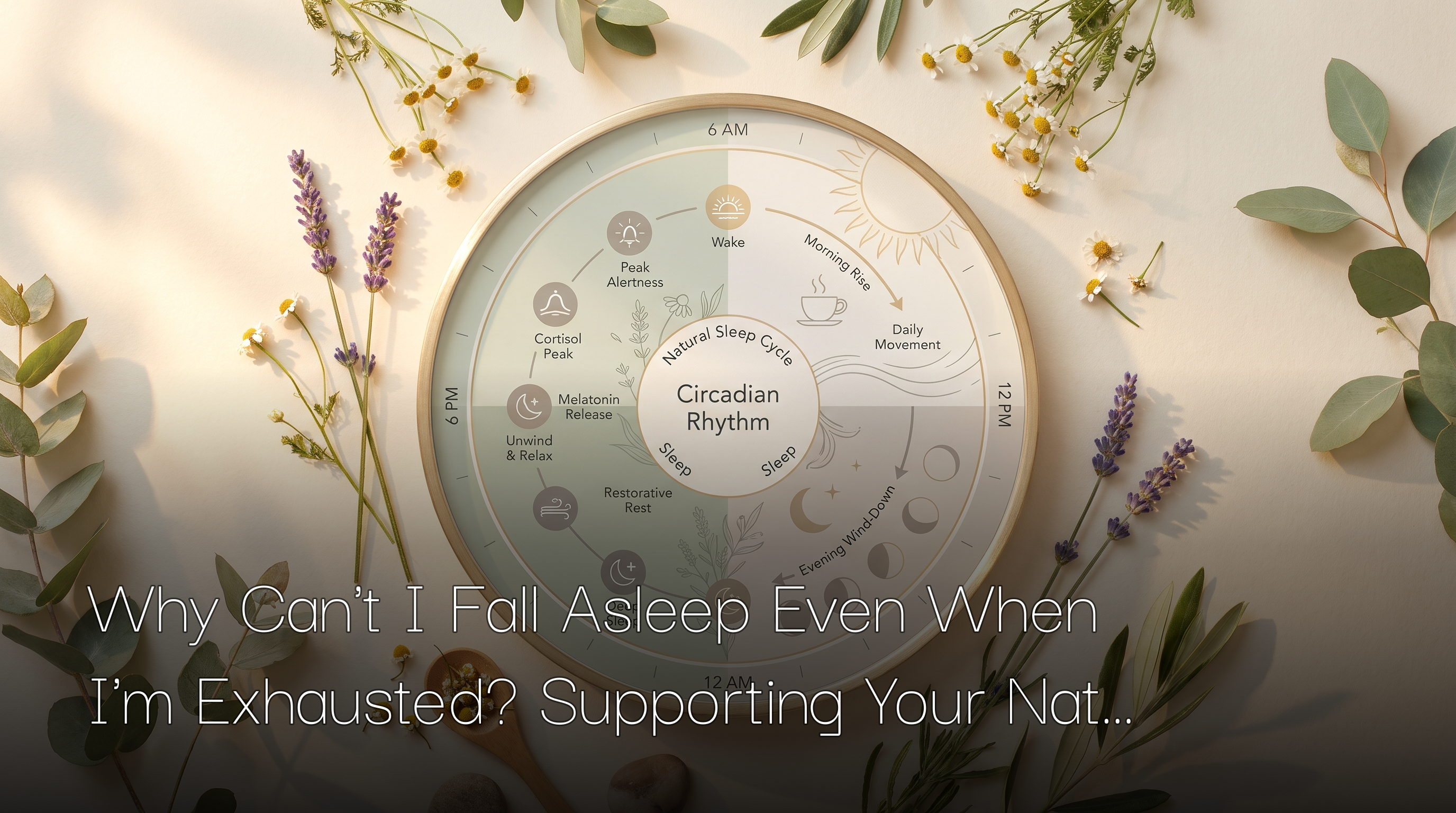
Why Can't I Fall Asleep Even When I'm Exhausted? Supporting Your Natural Sleep Cycle Through Daily Habits
Your Circadian Clock Is Running the Show: Supporting Your Natural Sleep Rhythm Through Daily Habits
meta-title: Support Your Natural Sleep Cycle with These Daily Habits
Consider this: at 2 a.m., a nurse finishing a rotating shift sits in her car for a moment before driving home, genuinely unsure whether her body is supposed to be asleep or awake. Her circadian clock, the internal biological timekeeper that should be making that call automatically, has lost its grip on the answer. Most people who experience the exhausted-but-wired feeling haven't worked a night shift in their lives, yet their biology is doing something surprisingly similar.
There's a specific reason this happens, and the explanation starts not with habits but with two competing systems inside your brain.
The Exhaustion-Insomnia Paradox (And Why It Makes Sense)
Your brain runs two separate systems that govern sleep. The first is sleep pressure, a chemical buildup of adenosine that accumulates the longer you've been awake. The more of it, the sleepier you feel. It's essentially your body keeping a debt ledger.
The second system is your arousal system, the network responsible for keeping you alert, reactive, and vigilant. Under normal conditions, these two systems take turns. Sleep pressure wins at night; arousal dominates during the day. Clean handoff.
Burnout, chronic stress, and anxiety disrupt that handoff badly. Elevated cortisol and sustained nervous system activation push the arousal system into overdrive, and it overpowers the sleep pressure signal even when your body is physically depleted (ScienceWorks Health). The result is that specific, miserable feeling: bone-tired but unable to settle, thoughts churning well past midnight, body exhausted while the brain refuses to downshift.
Physical exhaustion, on its own, does not guarantee sleep onset. Most of us operate as if it does, which is exactly why this pattern is so confusing when it first appears.
Circadian Rhythm Disruption: The Root Cause Nobody Talks About
Your circadian rhythm is your body's internal 24-hour clock, and it does a lot more than make you feel sleepy at night. It regulates body temperature, hormone release, digestion, and your natural melatonin cycle. When it runs cleanly, you never need to think about it. When it gets knocked off course, you feel it immediately.
Irregular sleep schedules, shift work, staying up late on weekends, and living out of sync with your natural chronotype can all produce the same outcome: tired throughout the day, wide awake at night (Sleep Cycle). Your body becomes genuinely confused about when it's supposed to be awake.
One of the most effective and underused tools for supporting your circadian rhythm is morning light exposure. Getting outside within an hour of waking, ideally for 10 to 20 minutes of natural daylight, helps anchor your internal clock to the actual time of day. Evening light, especially blue light from screens, does the opposite. It signals "midday" to your brain at exactly the wrong moment.
Blue light from phones, laptops, and tablets directly blocks melatonin production, the hormone your brain uses to initiate the transition toward sleep (GoodRx). Turning off all screens at least one hour before bed gives your natural melatonin cycle a real chance to work (HelpGuide). That's not a loose suggestion; it's one of the most concrete interventions the research supports.
Daily Habits That Are Quietly Wrecking Your Sleep
Most sleep problems aren't caused by one big thing. They're the product of several small things compounding through the course of a day, and a few patterns come up again and again.
Caffeine timing is one of the most underestimated. Caffeine has a half-life of roughly five to six hours, which means a 3 p.m. coffee still has half its stimulant load in your bloodstream at 8 p.m. If falling asleep is a consistent struggle, cutting caffeine off after noon is worth a genuine trial, not just a day or two. Naps are a similar case: they can be useful, but the research is specific about how. Long naps or naps taken later in the afternoon make it harder to fall asleep at night, reduce overall sleep quality, and increase nighttime waking (Healthline). Keeping naps to 20 to 30 minutes and finishing them before 3 p.m. preserves most of the benefit without the cost.
Evening exercise and alcohol both deserve a closer look than they usually get. Movement is genuinely one of the best things you can do for your sleep and recovery routine overall, but intense workouts should finish at least two hours before bed or they trigger a stress response that delays sleep onset (UnityPoint Health). Alcohol presents a similar mismatch between how it feels and what it does: a glass of wine might seem like it helps you wind down, but alcohol induces initial drowsiness while disrupting sleep quality through the rest of the night, producing more wakeups and less restorative deep sleep. It's a trade that doesn't pay off. Late meals follow the same logic. Digestion is metabolically active, and eating a large meal close to bedtime keeps your body in a physiological state that isn't compatible with winding down.
None of these require a complete lifestyle overhaul. Small, consistent adjustments compound into noticeably better nights over a few weeks.
The Anxiety Loop: When Worry About Sleep Becomes the Problem
Here's where things get particularly circular. Anxiety increases arousal and alertness, which delays sleep onset (Healthline). Then the frustration of lying awake creates more anxiety, which increases arousal further. Sleep disturbance is actually a recognized diagnostic symptom in some anxiety disorders; it's not just a side effect, it's part of the mechanism.
If you've ever caught yourself watching the clock and calculating how many hours you'll get if you fall asleep right now, you know this loop personally. Clock-watching is one of the most effective ways to stay awake. Keeping clocks out of sight is a straightforward step, but it doesn't address the underlying arousal.
For people stuck in this pattern, standard sleep wellness tips, the bedroom temperature, the screens, the wind-down routine, are necessary but often not sufficient on their own. Cognitive Behavioral Therapy for Insomnia (CBT-I) is the current gold-standard clinical approach for addressing arousal-driven insomnia. It targets the thought patterns and behavioral cycles that keep the arousal system elevated. In fact, for many people dealing with burnout-related or anxiety-related sleep disruption, it's the most direct route forward rather than a measure of last resort.
Building a Sleep Environment That Actually Works
Your bedroom sends signals to your brain before you even get under the covers. If you work in bed, scroll in bed, or watch TV in bed, your brain has learned to associate that space with wakefulness. Rebuilding that association takes deliberate effort.
Temperature is one of the most overlooked factors. The optimal bedroom temperature for sleep sits between 60 and 67 degrees Fahrenheit (UnityPoint Health), and a room that runs too warm is a common, easily corrected problem. Darkness matters for similar biological reasons: light suppresses melatonin, so blackout curtains or a sleep mask are among the cheapest and most effective changes available. A consistent wind-down ritual, whether reading, light stretching, or slow breathing, works because the consistency itself is the mechanism. A 15 to 20-minute routine trains your brain to expect sleep; the specific activity matters less than the reliable cue it sends each night (Cleveland Clinic). Phones, ideally, belong out of the bedroom entirely, not just on silent. The temptation to check is its own low-grade arousal trigger, even when the phone never lights up.
These aren't glamorous changes, but they work precisely because they're consistent and cumulative. One good night from a cold bedroom won't rebalance a disrupted circadian rhythm, but two weeks of the same environment and the same routine starts to rebuild something real.
When to Seek Professional Help
There's a meaningful difference between "I've been sleeping poorly lately" and a clinical sleep disorder. Insomnia, properly defined, isn't just about hours in bed; it's about sleep quality and how you function during the day (HelpGuide). If you're spending eight hours in bed and still dragging through your afternoons, that counts.
Conditions like insomnia disorder, anxiety disorders, depression, and narcolepsy all involve sleep disruption as a core feature, not just a side effect. If you've been applying good sleep hygiene consistently for several weeks without meaningful improvement, that's the signal to talk to a doctor rather than double down on the same habits.
A Practical Starting Point
Don't try to change everything at once. Pick two or three things and hold them for two weeks before adding more. Screens off one hour before bed, every night. Keep your room between 60 and 67 degrees. Cut caffeine off after noon. Build a consistent 15-minute wind-down ritual at the same time each night. Get morning light within an hour of waking.
That's a solid foundation for supporting more natural, restful sleep, and it costs nothing. The goal isn't perfection on night one. It's giving your nervous system enough consistent signals that it starts to trust sleep again.
If you're exploring additional natural sleep support options beyond lifestyle habits, there are science-backed wellness approaches worth looking into. We cover those in more detail elsewhere on the BioHarmony blog; feel free to explore and see what aligns with your sleep wellness goals.
Bioharmony Group
We believe true health starts from within.. Subscribe to my newsletter.
Why You're Exhausted Before the Day Starts (And How to Actually Fix It) Why You're Exhausted Before the Day Starts (And What Actually Helps) You slept eight hours. The alarm goes off. And somehow you feel worse than when you went to bed. If that sounds familiar, you're not alone, and more importantly, you're not broken. Morning exhaustion that doesn't match the hours you spent in bed is one of the most common complaints people bring to their doctors, and the reasons behind it are almost never...
Why You Feel So Anxious and Overwhelmed (And What Your Body Actually Needs) Why You Feel So Anxious and Overwhelmed (And What Your Body Actually Needs) Three browser tabs open. A message you haven't replied to. A to-do list that keeps growing. And somewhere in the middle of all of it, that tight, restless feeling in your chest that you can't quite shake. Sound familiar? You're not broken. What you're experiencing is your body doing exactly what it was designed to do, just in a context it...

Why Does My Skin Look Dull and Tired? How to Support Radiant Skin From Within You slept eight hours, drank your water, cleansed your face. And yet the mirror still shows someone who looks exhausted. It's frustrating, and it's more common than you'd think. Dull skin isn't one problem with one fix. It's usually several things happening at once, most of them well below the surface. Here's what's actually going on, and what you can do about it starting today. What Actually Causes Skin to Lose Its...